-1920x1920.webp&w=3840&q=75)
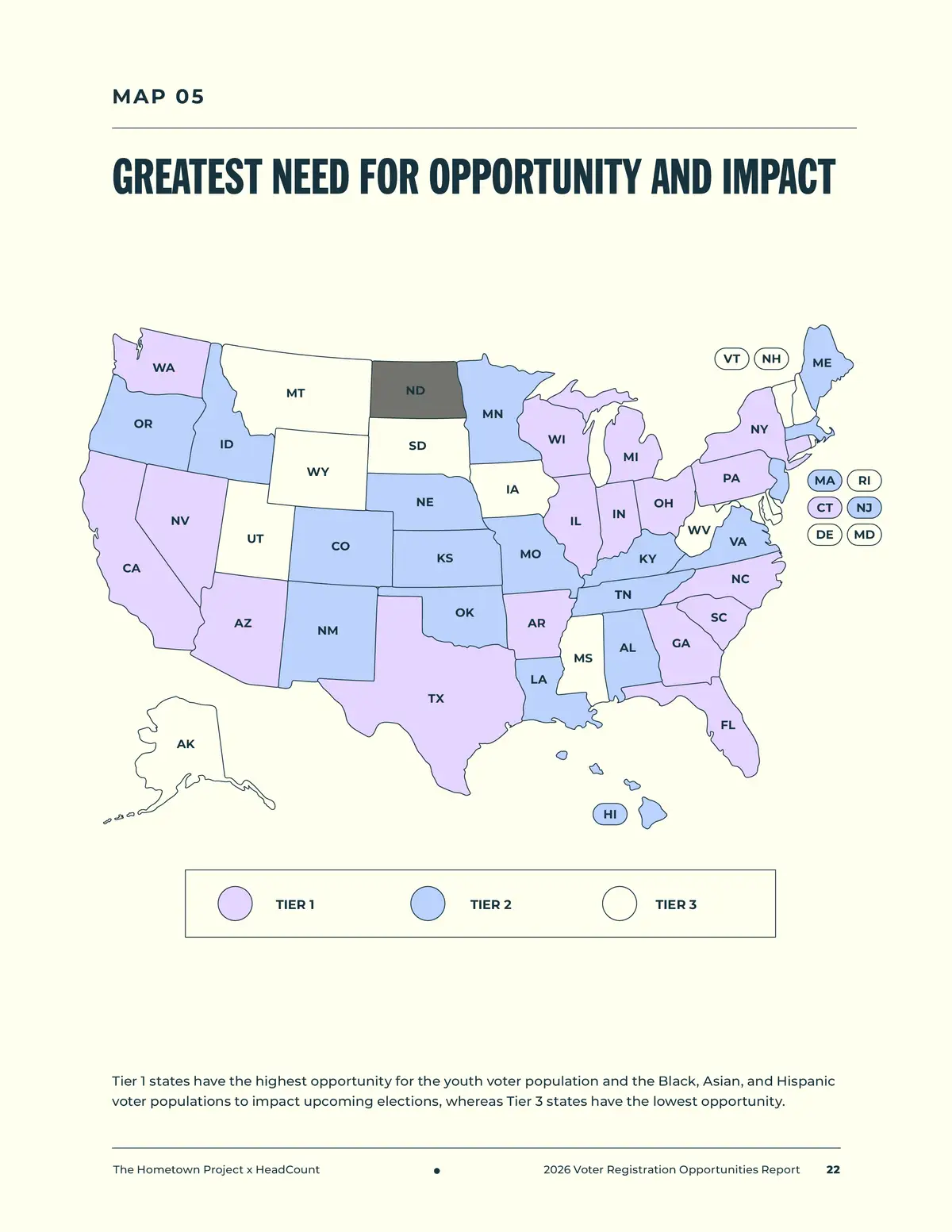
HeadCount and The Hometown Project have released a new report “Rethinking Voter Registration: A Data-Driven Roadmap to Save Democracy” covering research into voter registration gaps in the United States and strategic opportunities to bridge those gaps in specific states with young and diverse voter groups. The findings indicate that voter registration opportunities extend far beyond traditional presidential battlegrounds. The top ten states for overall voter registration opportunity are Florida, Arizona, California, Georgia, Illinois, New York, Texas, North Carolina, Connecticut, and Pennsylvania.
The report is now available here, and the summary of findings is below.
Which groups were targeted in this research, and where are the gaps?
- We identified young potential voters as unregistered people ages 18 to 34.
- Utilizing U.S. Census data, the research also examines voter registration gaps among eligible Black, Hispanic, and Asian potential voters.
The Gaps: The current make-up of elected officials disproportionately over-represents older, white voters.
- In 11 states, more than 40% of eligible young voters are unregistered.
- In six states, more than 1 million eligible voters of color are unregistered.
Impact on 2026 Elections: Young Voters Have Power
- In 28 states, the unregistered young potential voter population exceeds the estimated potential vote difference for the 2026 elections.
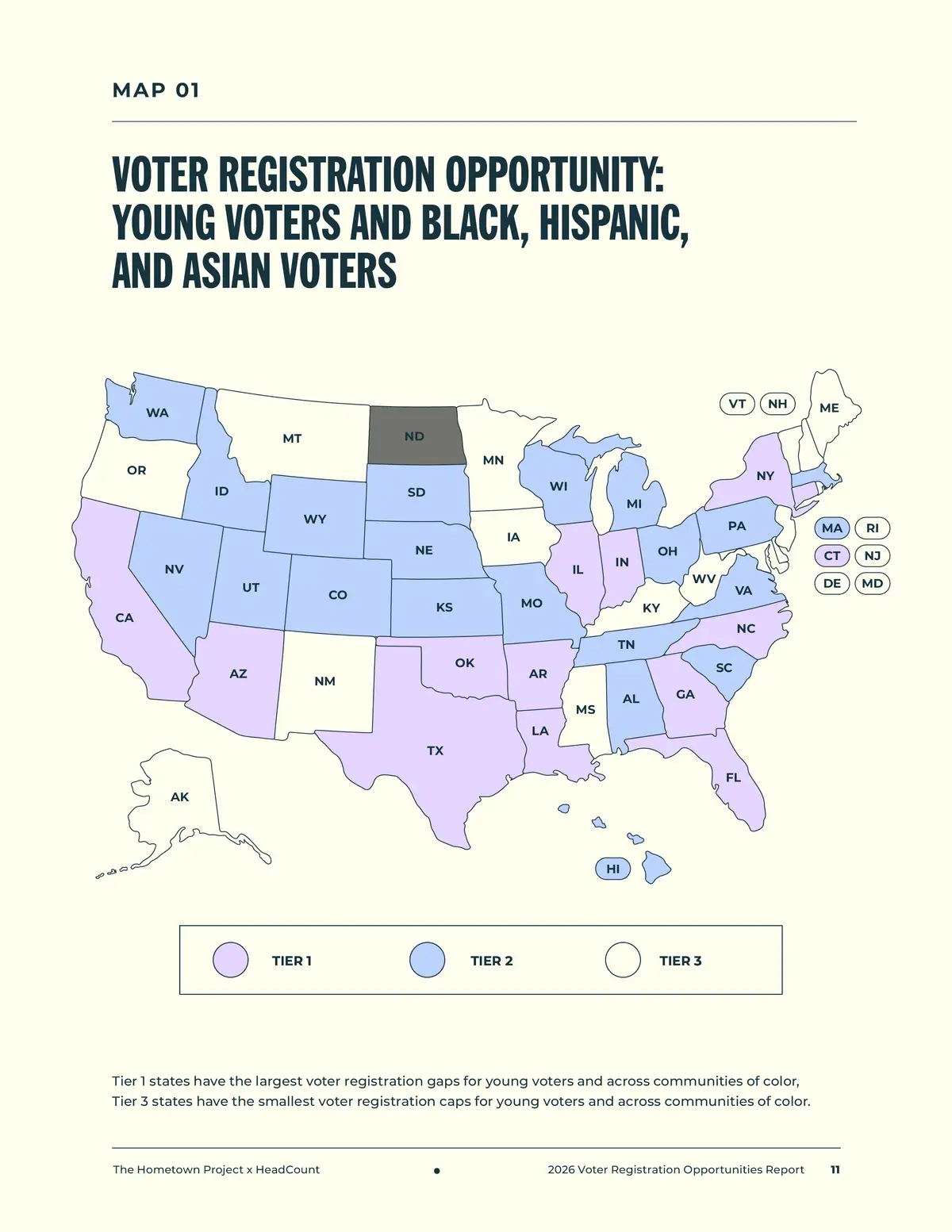
- Four states received the highest possible score in voter registration opportunities: Arizona, Florida, Texas, and New York, due to high numbers of unregistered young voters 18-24.
- The 15 states with the largest population of 15-17 year olds are: Arizona, California, Florida, Georgia, Illinois, Indiana, Michigan, New Jersey, New York, North Carolina, Ohio, Pennsylvania, Texas, Virginia, and Washington. Eight out of those 15 states have pre-registration available to future voters aged 16-17, highlighting the need for both in-person and digital campaigns focused specifically on educating young people on pre-registration opportunities.
Impact on 2026 Elections: Voters of Color Have Power
- In 18 states, the unregistered Black, Hispanic, and Asian combined populations exceed the estimated potential vote difference for the 2026 elections.
- Three states received the highest score for registration gap in communities of color: Arizona, Florida, and Louisiana.
Area of Opportunity - Access to Online Voter Registration
- Location shapes how easy it is to register to vote, with only eight states currently allowing online voter registration without requiring a DMV-issued ID: California, Delaware, Kentucky, Minnesota, Missouri, New Jersey, Pennsylvania, and Vermont.
- Innovative and robust digital and field voter registration campaigns in above states should highlight the availability of online voter registration, and further lobbying is possible for the expansion of online voter registration opportunities in other states.
Key Takeaways for 2026
- Voter registration investments must be more targeted, place-based, and responsive to specific barriers.
- Sustained organizing rooted in community and trust is key to a representative democracy.
- The top 10 states that have been identified as the greatest need and opportunity for impact are: Florida, Arizona, California, Georgia, Illinois, New York, Texas, North Carolina, Connecticut, and Pennsylvania.
We believe in the power of bringing voter registration to populations that need them most — expanding voter registration is one of the most proven ways to build a more representative electorate.
When more people are registered, more people participate. And when more people participate, our democracy better reflects the country it serves.
The full report including all 50 state data tables, methodology, and possible solutions can be found here.
For questions about this report, please contact info@headcount.org or info@hometownproject.org.